
Laing, David, 1793-1878 (antiquarian, bookseller, and librarian of the Signet Library)
Biography
David Laing, eminent historian, antiquary and bibliographer, was the second son of the Edinburgh bookseller William Laing (1764-1832) and his wife Helen Kirk, and was born on 20 April 1793. He was educated at the Canongate Grammar School and later on attended Greek classes at the University of Edinburgh. At the age of fourteen, he became apprenticed to his father who, at the time, was the only bookseller in Edinburgh dealing in foreign literature. Laing was able, occasionally, to travel abroad in search of rare or curious books. In 1821, he became a partner in his father's business and throughout his life he was an avid collector of manuscripts and rescued many from destruction. The first published work of his own was Auctarium Bibliothecae Edinburgenae sive Catalogus Librorum quos Gulielmus Drummondus ab Hawthornden D.D.Q. Anno 1627 (1815). Among other works, Laing also reprinted Thomas Craig's Epithalamium on the marriage of Darnley and Mary Stuart (1821). When Sir Walter Scott founded the Bannatyne Club in 1823 for the printing of material and tracts relating to Scottish history and literature, Laing - a friend of Scott's - became Secretary of the Club and chief organiser until its dissolution in the 1860s. Laing was also associated with the Abbotsford Club, the Spalding Club, and the Wodrow Society, each of which had been set up for the publication of manuscripts and for the revival of old texts. When the keepership of the Advocates' Library fell vacant in 1818, Laing was a candidate but was not elected. He became Keeper of the Library to the Society of Writers to Her Majesty's Signet, a post which he occupied from 1837 until his death. On his appointment to the post, he gave up his business as a bookseller and disposed of the stock in a public sale. Laing died at Portobello, in Edinburgh, on 18 October 1878.
Found in 180 Collections and/or Records:
Scholia by pseudo-Acro, 15th century
Section V. Laing Charters, 854-1837
After the death of David Laing, his private library was sold in an auction occupying thirty-one days. His collection of charters and other papers is of national importance and the most distinguished of its kind in any Scottish university. It is an essential source for the 18th century, and a much used one for all periods of Scottish history from the earliest times. The Laing Collection falls into five sections, designated as La.I., La.II., La.III., La.IV., and La.V.
Sermon by Arnoldus Creveterodt, 1521
Sermons and other theological material, 14th century
This is a fragment (8 folios) of a 14th century manuscript that contains various short sermons and other theological material.
Writing
The script is French or Italian.

Specimens of calligraphic styles of writing, 1570-1624 (approximate)
Statuta Anglie (List of English Statutes), 14th century
Statuta Anglie [lost during WWII], 14th century
This manuscript was lost during the Second World War. It was a 14th-century English manuscript in vellum, written in Latin and in French, which contained a list of medieval statutes and other laws issued by the Kingdom of England before the development of the English Parliament. A more detailed description can be found in Catherine Borland's catalogue (1916): MS 157 (external link).
Summa Confessionalis by Antoninus, Archbishop of Florence, 1 September 1472
Summa summarum sive Speculum iuris canonici, by William of Pagula, 14th century
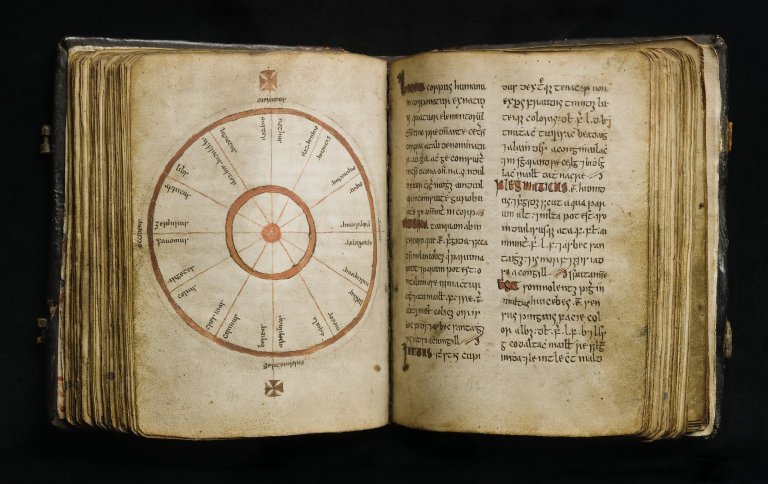
The Laing Collection
After the death of David Laing, his private library was sold in an auction occupying thirty-one days. His collection of charters and other papers is of national importance and the most distinguished of its kind in any Scottish university. It is an essential source for the 18th century, and a much used one for all periods of Scottish history from the earliest times. The Laing Collection falls into five sections, designated as La.I., La.II., La.III., La.IV., and La.V.